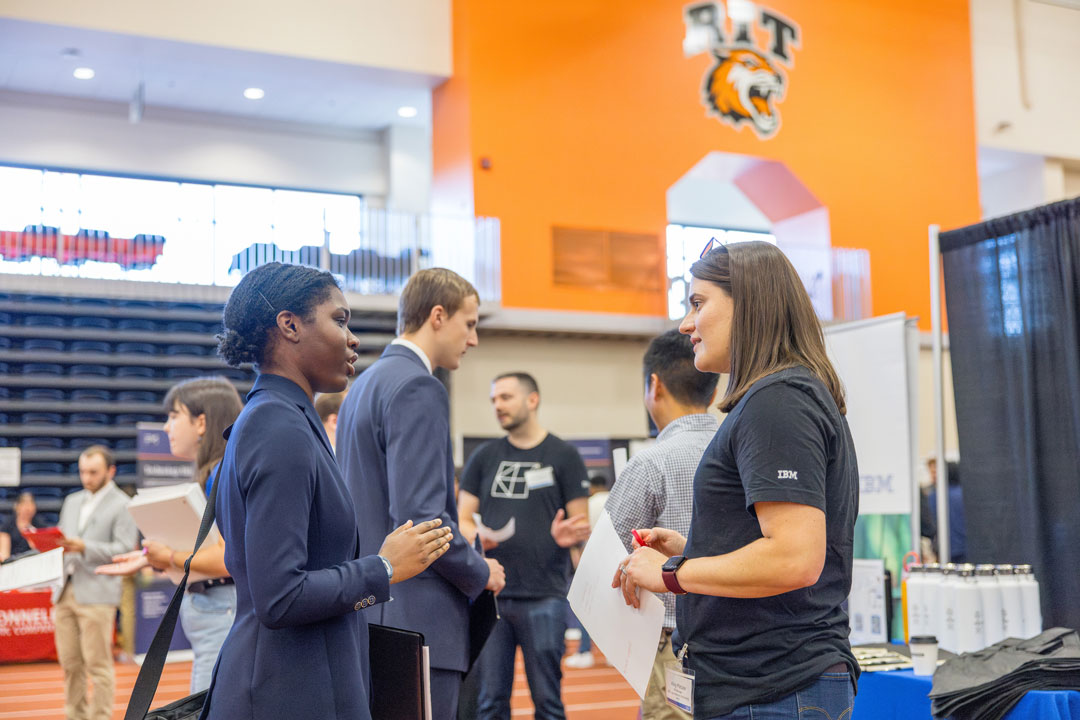
Supply chain disruptions create opportunities for RIT students
Tue, 06 Oct 2026 03:13:03 EDT
When Ian Anderson explains to family members that he's studying global supply chain management at Rochester Institute of Technology they are initially confused.
“When I give them my elevator pitch, they go, ‘Oh, that makes sense. It’s actually a really good thing to be getting into right now,’” said Anderson, a graduate student in RIT’s Saunders College of Business , who wanted a career that could put his contracting and project management background to use. Supply chain management gave him that.
What is supply chain management?
Supply chain management deals with managing the flows of materials from its source, to the manufacturers that make the components, the ultimate assemblers who bring all those pieces together, and finally, to the logistics companies that move and store the products on their way to the final consumer.
The Saunders program, which boasts a 100 percent co-op placement rate , paired with the university’s nationally ranked co-op and internship program allows students to learn on the job and define their career paths. A recent cohort of supply chain management students, including Anderson, completed co-ops at aerospace and defense company L3Harris, with all of them receiving job offers before graduation.
According to the U.S. Bureau of Labor Statistics, employment of logisticians–one of the core roles within supply chain management–is projected to increase 17 percent over the next 10 years, about five times the average projected across all occupations. It’s a number that Kevin Sweeney , chair of Saunders’ supply chain management program, thinks is conservative.
“Supply chains are constantly being disrupted,” said Sweeney. “Those disruptions actually lead to more opportunities, because there’s more problems to be solved.”
For many incoming students, supply chain isn’t a career they’ve ever considered, mostly because of a lack of awareness. High schoolers graduate with a general sense of what marketers or accountants do, Sweeney said, but supply chain management rarely comes up before college. He sees it as an advantage. Without preconceived notions, students are more apt to learning the work from the ground up.
“I get to rebuild them,” Sweeney said. “They are a lot more malleable for me than maybe they would be for some other disciplines.”
RIT and its nationally ranked business college prepares students for careers by adapting to industry changes. Global trade coursework, for example, now goes beyond the mechanics of executing a shipment to strategic questions about how tariffs reshape a company's entire supply network, and which cost increases a business can absorb temporarily versus permanently. It’s reinforced by outside experts that department professors bring in, including a recent visit by a former import-export policy official from the George H.W. Bush administration.
Above all, Sweeney said, the program teaches judgment over any single technique, since every company weighs cost, speed, and risk differently.
Anderson learned firsthand on a site visit to CooperVision, where the company’s supply chain centered almost entirely on forecasting and inventory for a complex product line—a sharp contrast to his current work managing supplier contracts at L3Harris.
“You get this broad set of skills,” Anderson said. “And you could shift yourself to focus on any one of them, depending on what job you're going into.”